Prime factorisation, GCD and LCM in Scientific calculator plus 991 for Android
Type a number and press SHIFT °'" (FACT) to break it into prime factors: 1014 becomes 2 × 3 × 13². A fraction factorises too, with negative exponents for the primes of the denominator: 3/8 becomes 2⁻³ × 3. ALPHA × types GCD, the greatest common divisor, also called the HCF: GCD(8, 12) is 4. ALPHA ÷ types LCM, the least common multiple: LCM(8, 12, 6) is 24.
- Prime factors
- a number or fraction, then SHIFT °'" (FACT)
- GCD, LCM
- ALPHA × (GCD), ALPHA ÷ (LCM)
- Between numbers
- a comma, SHIFT )
- Also called
- HCF; lowest common multiple
Three functions deal with divisors and multiples. FACT, printed in yellow for SHIFT, writes a number as a product of primes. GCD and LCM, printed in violet for ALPHA, find the largest number that divides each of the numbers in the brackets, and the smallest number that is a multiple of each.
Prime factors: FACT
To find the prime factors of a number
-
Type the number.
-
Press SHIFT °'" FACT and the answer appears straight away: no = is needed.
in 1014
out 2 × 3 × 13²
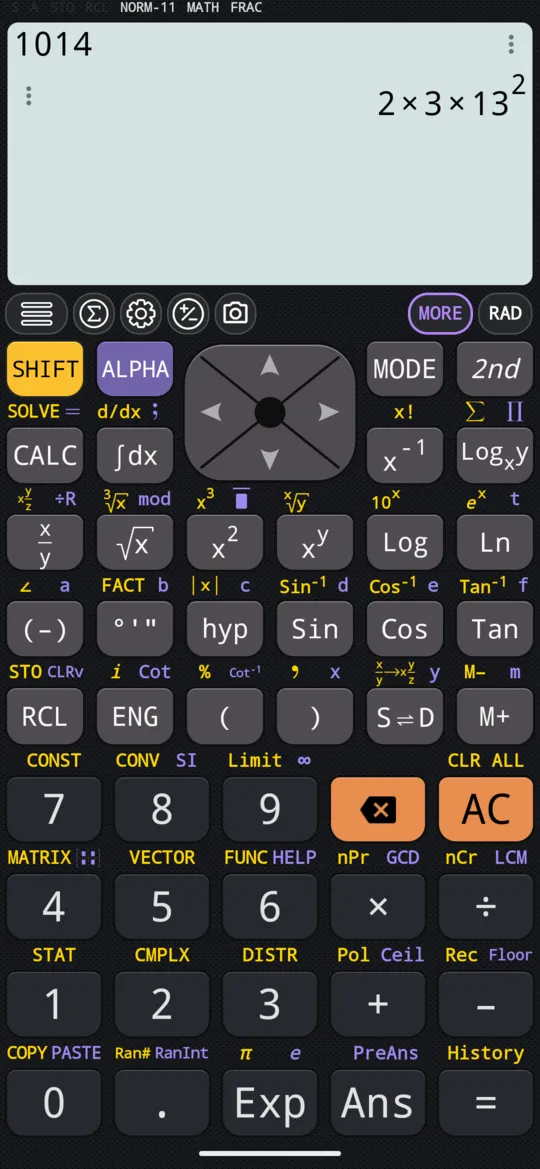
A fraction factorises too. Type it with the fraction key, 3, x/y, 8, then press SHIFT °'" FACT as before (typing fractions). The primes of the denominator come back with negative exponents:
in 3/8
out 2⁻³ × 3
An extremely large number can exceed the memory available; the calculator then shows Out of memory.
The greatest common divisor: GCD
The greatest common divisor, also called the highest common factor (HCF), is the largest whole number that divides each of the numbers exactly. Press ALPHA × GCD and the key types GCD with its opening bracket. Type the numbers, pressing SHIFT ) , for the comma between one and the next, and press =.
in GCD(8, 12)
out 4
The least common multiple: LCM
The least common multiple, also called the lowest common multiple, is the smallest whole number that is a multiple of each of the numbers. It is on ALPHA ÷ LCM and is typed the same way, here with three numbers:
in LCM(8, 12, 6)
out 24
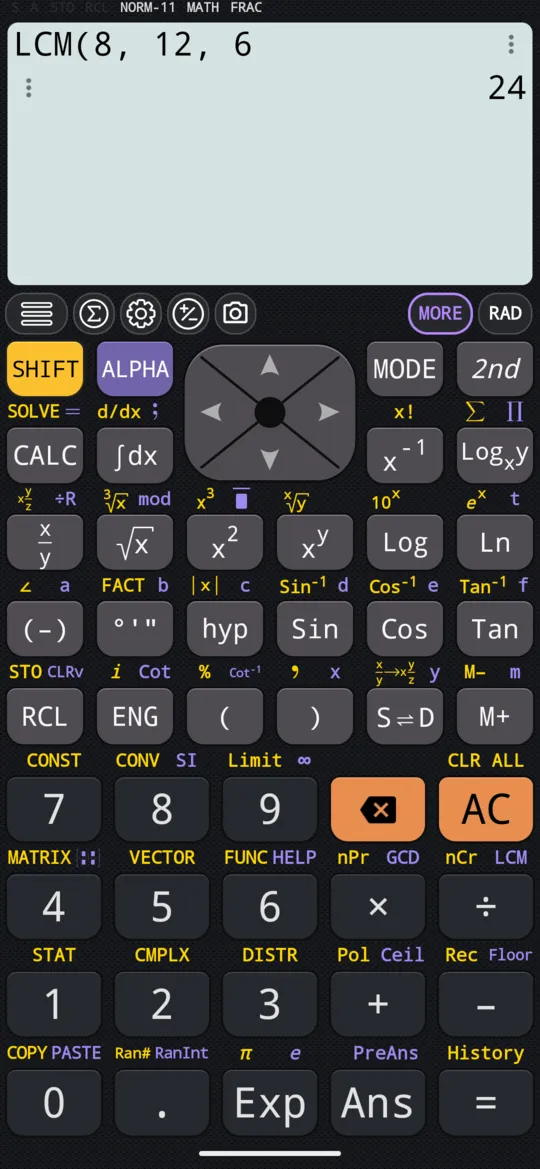
The closing bracket can be left off: = works the calculation out as if it were closed, and the input line keeps it open, as typed.
At a glance
| Keys | Function | Example |
|---|---|---|
| SHIFT °'" FACT | Prime factors | 1014 → 2 × 3 × 13² |
| x/y | A fraction to factorise | 3/8 → 2⁻³ × 3 |
| ALPHA × GCD | Greatest common divisor | GCD(8, 12) = 4 |
| ALPHA ÷ LCM | Least common multiple | LCM(8, 12, 6) = 24 |
| SHIFT ) , | The comma between numbers |
Questions
How do I find the prime factors of a number?
Type the number and press SHIFT °'" (FACT); no = is needed. The answer is the number as a product of primes, repeated primes written as powers: 1014 comes back as 2 × 3 × 13².
Can it factorise a fraction?
Yes. A factor in the denominator gets a negative exponent: 3/8 is 2⁻³ × 3. Type the fraction with the x/y key, then press SHIFT °'" (FACT).
How do I find the LCM of three numbers?
Press ALPHA ÷ (LCM), type 8, 12 and 6 with a comma between each (the comma is SHIFT and the ) key), and press =: LCM(8, 12, 6) is 24. The closing bracket can be left off.
Is GCD the same as HCF?
Yes. The greatest common divisor (GCD) and the highest common factor (HCF) are two names for the same number, the largest whole number that divides each of the numbers exactly: GCD(8, 12) is 4. The least common multiple, LCM, is also called the lowest common multiple.
Related pages
- Remainders, mod, floor, ceiling and absolute value mod and ÷R, rounding down and up, and the absolute value
- Factorials, combinations (nCr), permutations (nPr) and random numbers n!, nCr and nPr, plus Ran# and RanInt for random numbers
- Fractions, mixed numbers and recurring decimals x/y and SHIFT x/y, adding and subtracting them, recurring decimals, S⇌D
- Numbers, arithmetic and complex numbers which mode and which page, the keys, and how numbers are held
Written from the calculator's own manual and from the app itself, version 7.6.0; every figure is one the manual shows or a capture of the app proves. Last revised on 29 September 2026.
Bug reports and feature requests go to kimcuc@samatica.com — a person reads it.