Binomial, Poisson and geometric probabilities in Scientific calculator plus 991 for Android
The distribution menu, SHIFT 3 (DISTR), has a pdf and a cdf for each of the three counting distributions. binompdf(numtrials, p, x) is the probability of exactly x successes, and binomcdf the probability of x or fewer; poissonpdf and poissoncdf take the mean first, then the count; geometpdf gives the chance that the first success comes on trial x, and geometcdf on trial x or earlier. Put a list in the x slot to answer several questions at once, or leave x out of a binomial for the whole table.
- Binomial
- binompdf, binomcdf(numtrials, p[, x])
- Poisson
- poissonpdf, poissoncdf(mean, x)
- Geometric
- geometpdf, geometcdf(p, x)
- Outcomes
- x, one whole number or a list in { }
These three distributions count things rather than measure them, so x is a whole number: successes in a fixed number of trials (binomial), events in a stretch of time or space (Poisson), or the trial on which the first success arrives (geometric). Each has two functions on the calculator. A pdf gives the probability of exactly one outcome, and a cdf adds up every outcome from the bottom to x.
All six are on the distribution menu, SHIFT 3 DISTR; type part of a name in its search box to narrow the list, as on the normal distribution.
Binomial
binompdf(numtrials, p[, x]) is the probability of exactly x successes in numtrials independent trials, each succeeding with probability p. Exactly 3 successes in 8 trials at probability 0.7:
in binompdf(8, 0.7, 3)
out 0.04667544
binomcdf(numtrials, p[, x]) adds up every outcome from 0 to x instead: the probability of x successes or fewer. Three or fewer successes in 5 trials at probability 0.6:
in binomcdf(5, 0.6, 3)
out 0.66304
How to work out a binomial probability
-
If DECI is not on the status line, press S⇌D to switch to numeric calculation.
-
Press SHIFT 3 DISTR and choose binompdf for exactly x, or binomcdf for x or fewer.
-
Type the number of trials, the probability of success and x, pressing SHIFT ) , between one and the next, then press =.
For at least x successes, take the probability of x − 1 or fewer away from 1: 1 − binomcdf(numtrials, p, x − 1).
The whole table, or several outcomes
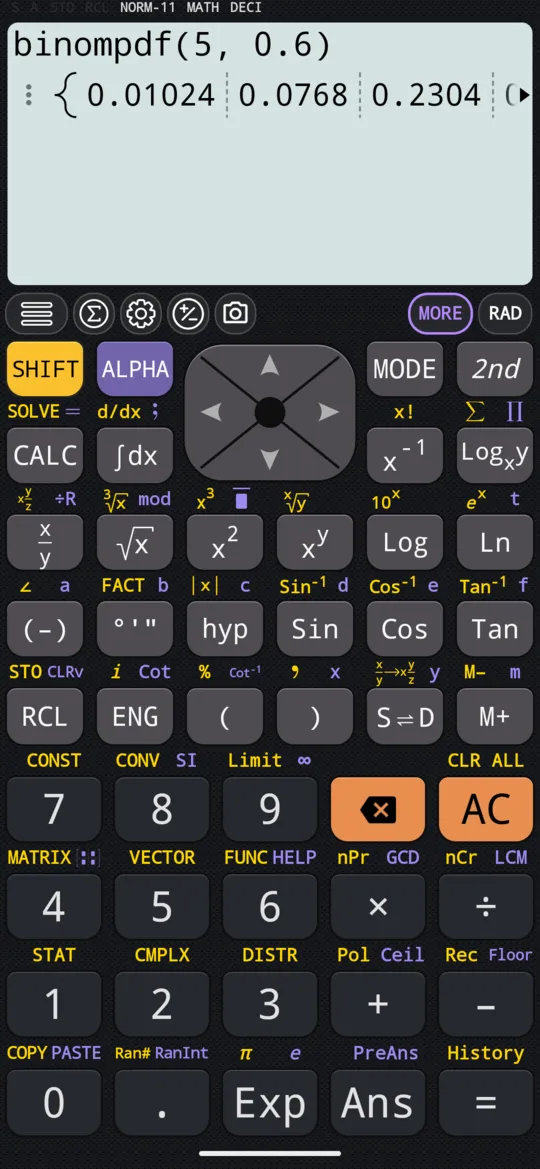
In binompdf and binomcdf, x is optional. Left out, the answer is not one probability but the whole table, every outcome from 0 successes up to numtrials, in order; for binomcdf it is the cumulative table, each entry that many successes or fewer:
in binompdf(5, 0.6)
out {0.01024, 0.0768, 0.2304, 0.3456, 0.2592, 0.07776}
Reading along it: the chance of no successes is 0.01024, of one 0.0768, and so on up to all five at 0.07776.
A list in the x slot picks out several outcomes at once. Type the braces from the 2nd keyboard, where { and } have keys of their own, and press 1st to turn back for the numbers. These are the last three entries of the table:
in binompdf(5, 0.6, {3, 4, 5})
out {0.3456, 0.2592, 0.07776}
The same list in binomcdf answers three "or fewer" questions at once. The last entry is 1, because five or fewer successes out of five is certain:
in binomcdf(5, 0.6, {3, 4, 5})
out {0.66304, 0.92224, 1}
Poisson
poissonpdf(mean, x) is the probability of exactly x events when the average number is mean, which must be greater than 0. The mean comes first and the count second, so this is 10 events where 6 were expected:
in poissonpdf(6, 10)
out 0.04130309341
poissoncdf(mean, x) is the probability of x events or fewer. A list in the x slot answers several questions at once: at most 0, 1, 2 or 3 events where 0.126 were expected:
in poissoncdf(0.126, {0, 1, 2, 3})
out {0.88161484678, 0.99269831748, 0.99969657613, 0.999990503}
Geometric
geometpdf(p, x) is the probability that the first success arrives on trial number x, when each trial succeeds with probability p. The first success on the 6th try, at probability 0.4:
in geometpdf(0.4, 6)
out 0.031104
geometcdf(p, x) is the probability that it arrives on trial x or earlier. A fair coin, and the first head by the 1st, 2nd or 3rd toss:
in geometcdf(0.5, {1, 2, 3})
out {0.5, 0.75, 0.875}
In symbolic calculation the same three come back as {1/2, 3/4, 7/8}.
At a glance
| Function | Gives |
|---|---|
| binompdf(numtrials, p[, x]) | Exactly x successes; the whole table with x left out |
| binomcdf(numtrials, p[, x]) | x successes or fewer; the cumulative table with x left out |
| poissonpdf(mean, x) | Exactly x events |
| poissoncdf(mean, x) | x events or fewer |
| geometpdf(p, x) | The first success on trial x |
| geometcdf(p, x) | The first success on trial x or earlier |
Questions
How do I work out a binomial probability?
Press SHIFT 3 (DISTR), choose binompdf, and give it the number of trials, the probability of success and the number of successes: binompdf(8, 0.7, 3) is 0.04667544, the probability of exactly 3 successes in 8 trials. For x or fewer, use binomcdf instead: three or fewer successes in 5 trials at probability 0.6, binomcdf(5, 0.6, 3), is 0.66304.
How do I get the whole binomial table?
Leave x out. binompdf(5, 0.6) returns every outcome from 0 successes up to 5, in order: {0.01024, 0.0768, 0.2304, 0.3456, 0.2592, 0.07776}. binomcdf with x left out gives the cumulative table the same way.
What order do the Poisson arguments go in?
The mean first, then the count. poissonpdf(6, 10) is the probability of 10 events where 6 were expected, 0.04130309341. poissoncdf takes the same two, and gives the probability of the count or fewer.
Why do I get a fraction instead of a decimal?
The calculator is in symbolic calculation, which keeps the answer exact: binomcdf(5, 0.6, 3) comes back as 2072/3125, and a Poisson answer is written in terms of e. Press S⇌D to switch to numeric calculation.
Related pages
- Normal distribution normalcdf, invNorm and normalpdf, and the one-sided trick
- Student-t, chi-square and F distributions tcdf, invT and tpdf; χ²cdf and χ²pdf; Fcdf and Fpdf
- Statistics and probability which tool for which job, and what each page of the chapter covers
Written from the calculator's own manual and from the app itself, version 7.6.0; every figure is one the manual shows or a capture of the app proves. Last revised on 29 September 2026.
Bug reports and feature requests go to kimcuc@samatica.com — a person reads it.