Solve polynomial inequalities of degree 2, 3 and 4 in Scientific calculator plus 991 for Android
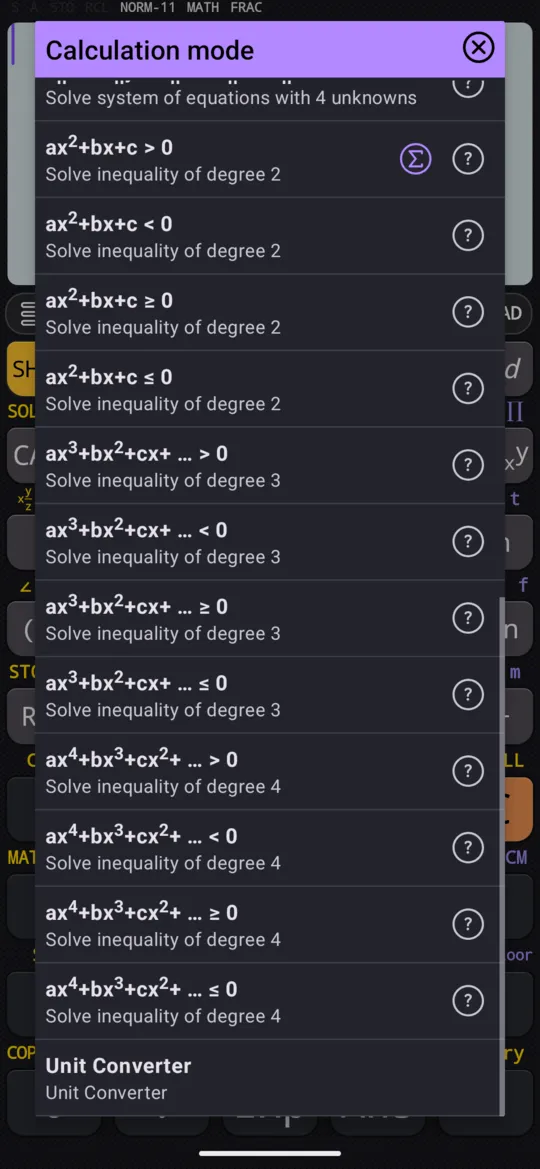
Press MODE and choose the Solve inequality of degree 2, 3 or 4 entry for your relation, >, ≥, < or ≤ against zero. Type the coefficients, pressing = after each, and press = again. The solution set comes back as intervals, one to a line and read as "or": x² − x − 2 > 0 gives x < −1 on one line and 2 < x on the next.
- Modes
- degree 2, 3 or 4, one for each of >, ≥, < and ≤ against 0
- You type
- the coefficients, highest power first
- You get
- intervals, one per line, read as "or"
- Bounds
- the real roots; closed for ≥ and ≤, open for > and <
The answer to an inequality is a set of values rather than a number, and the calculator gives it as one: a short list of intervals, with the real roots of the polynomial as their ends. The inequality has to compare a polynomial with 0, so move every term to one side first.
The four relations
Each degree has a separate mode for each relation. They share the same Coefficient Editor and the same steps, and differ only in the comparison with 0.
| Relation | Means | Its bounds |
|---|---|---|
| > 0 | Strictly greater | Open, written with < |
| ≥ 0 | Greater or equal | Closed, written with ≤ |
| < 0 | Strictly less | Open |
| ≤ 0 | Less or equal | Closed |
Solve it
To solve a polynomial inequality
-
Press MODE and choose the entry for your degree and relation. Each shows the inequality it solves, such as ax²+bx+c > 0, above the words Solve inequality of degree 2, 3 or 4. The Coefficient Editor appears, one cell for each coefficient.
-
Type the coefficients from the highest power down, pressing = after each. Enter 0 for a term the polynomial leaves out.
-
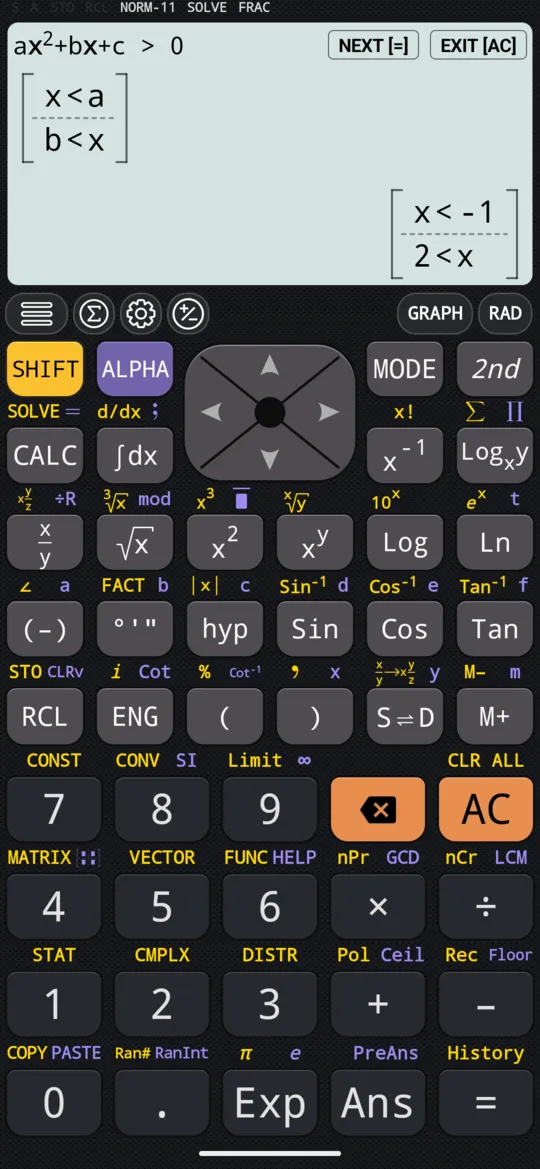
Press = again, or tap SOLVE [=]. The whole solution set appears on one page.
-
Press AC or = to go back to the editor and solve again.
x² − x − 2 > 0
| a | b | c |
|---|---|---|
| 1 | -1 | -2 |
out [x < -1; 2 < x]
x² − x − 2 = (x + 1)(x − 2), so the parabola opens upward and is positive outside its roots, −1 and 2.
Reading the answer
The solution set is stacked one interval to a line, and the lines are read as "or": x is a solution when it satisfies any one of them. Each line takes one of four shapes, with the real roots of the polynomial as its ends.
- x < a: everything to the left of a.
- a < x: everything to the right of a.
- a < x < b: everything strictly between two roots.
- x = a: a single isolated point, at a repeated root where the polynomial only touches 0.
With ≥ and ≤ the ends are included, and the lines use ≤; with > and < they are left out. Complex roots are ignored: they are not points on the number line, so they cannot be ends.
The same coefficients with ≤ instead of > give the complementary set, between the roots and including them:
x² − x − 2 ≤ 0
out [-1 ≤ x ≤ 2]
A perfect square with ≤ collapses to a single point: (x − 1)² ≤ 0, entered as a = 1, b = −2, c = 1, gives x = 1 alone, on a single line.
Degree 3
A cubic changes sign at each root it crosses, so its solution set alternates from one root to the next.
x³ − 2x² − x + 2 > 0
| a | b | c | d |
|---|---|---|---|
| 1 | -2 | -1 | 2 |
out [-1 < x < 1; 2 < x]
x³ − 2x² − x + 2 = (x + 1)(x − 1)(x − 2), so the sign alternates across −1, 1 and 2.
At a repeated root the curve touches 0 without crossing, and the sign does not change there. With ≥ or ≤ that touching point is part of the answer, either inside a neighbouring interval or on a line of its own:
x³ − 10x² + 33x − 36 ≥ 0
out [x = 3; 4 ≤ x]
Entered as a = 1, b = −10, c = 33, d = −36. The polynomial is (x − 3)²(x − 4): at 3 it only touches 0, and from 4 on it is positive. With > 0 instead, the touching point drops out and 4 < x is left alone.
Degree 4
A quartic works the same way, with up to four real roots for ends.
x⁴ − 3x² − 4 < 0
| a | b | c | d | e |
|---|---|---|---|---|
| 1 | 0 | -3 | 0 | -4 |
out [-2 < x < 2]
x⁴ − 3x² − 4 = (x² − 4)(x² + 1). The factor x² + 1 has no real root, so the only ends are −2 and 2.
x⁴ − 4x³ − 12x² ≥ 0
out [x ≤ -2; x = 0; 6 ≤ x]
Entered as a = 1, b = −4, c = −12, d = 0, e = 0. The polynomial is x²(x − 6)(x + 2), and the double root at 0 is an isolated point between the two rays.
No solution, or every x
When the curve never crosses the relation, there are no intervals to show, and a dialog says so instead.
- No solution: the set is empty. x² + x + 1 < 0 has none, because that parabola is positive everywhere; x⁴ + 1 < 0 has none either.
- Infinite solution: every real number is a solution, as for x² + x + 1 > 0 or x⁴ + 1 > 0.
A cubic always crosses 0, so it always has a solution and is never solved by every x. With every coefficient 0, the inequality becomes 0 compared with 0: No solution for > and <, Infinite solution for ≥ and ≤. OK returns to the editor.
See it on a graph
Press GRAPH at any time, while typing the coefficients or with the answer on screen. Two things are drawn together: the curve of the polynomial with its roots marked, and a shaded region, which is the solution set itself.
The shading is a vertical band running the whole height of the graph, because the condition only involves x. Its width along the x-axis is the answer: read it from left to right. It is not the area between the curve and the axis; the curve is only there to show where the polynomial crosses 0.
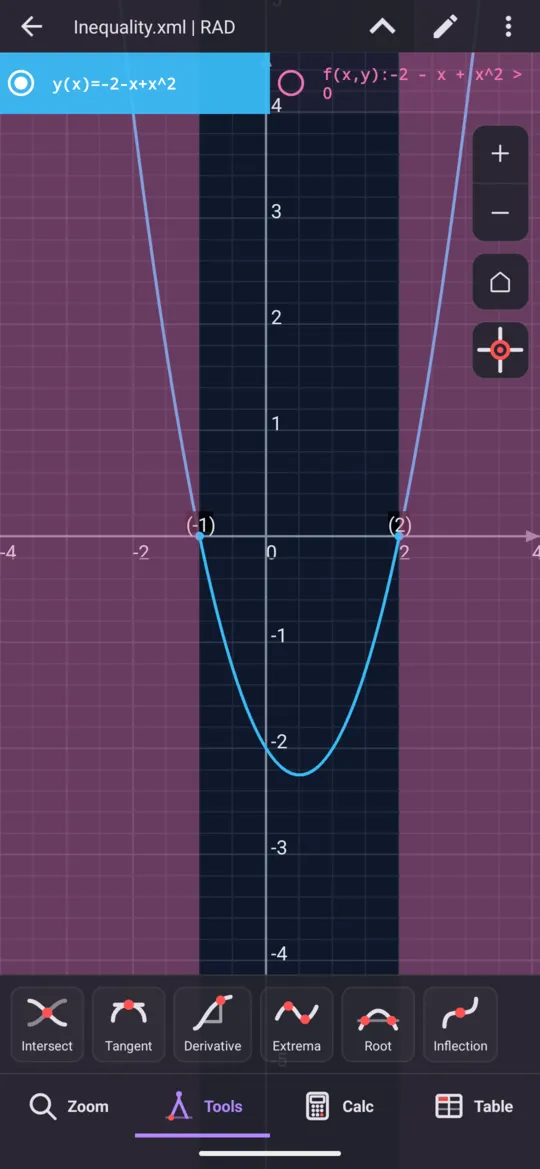
Change the relation and only the shading moves: with < instead of >, the same curve is shaded between −1 and 2.
At a glance
| Key | What it does |
|---|---|
| MODE | Choose the Solve inequality of degree 2 entry, or 3 or 4, for your relation |
| = | Evaluates a cell and moves on; once every cell is in, solves; with the answer showing, back to the editor |
| left right | Move between the cells |
| AC | Empties every cell; with the answer showing, back to the editor |
| GRAPH | Plots the curve with its roots, and shades the solution set |
Tap the answer to switch it between fractions and decimals; an irrational end such as √2 is then shown either as an exact radical or as a decimal.
Questions
How do I solve a quadratic inequality?
Move everything to one side so the inequality compares a polynomial with 0. Then press MODE, choose the Solve inequality of degree 2 entry for the relation, type a, b and c, and press =. x² − x − 2 > 0 gives x < −1 and 2 < x, on two lines read as "or"; with ≤ instead, the same coefficients give −1 ≤ x ≤ 2.
Why are there two or three lines in the answer?
Because the solution set is not always one interval. Each line is one piece of it, and a value of x is a solution when it satisfies any one line. x⁴ − 4x³ − 12x² ≥ 0 needs three: x ≤ −2, the single point x = 0, and 6 ≤ x.
What does x = 3 mean in an inequality answer?
It is an isolated point: a repeated root where the polynomial touches 0 without changing sign. It only appears with ≥ or ≤, which include the value 0 itself. x³ − 10x² + 33x − 36 ≥ 0, which is (x − 3)²(x − 4), gives x = 3 on one line and 4 ≤ x on the next.
What if every x is a solution, or none is?
Then there are no intervals to show, and a dialog says so instead: No solution when the set is empty, as for x² + x + 1 < 0, and Infinite solution when every real number satisfies the inequality, as for x² + x + 1 > 0.
Related pages
- Solve a quadratic equation both roots, the vertex, complex roots and the graph
- Solve cubic, quartic and quintic equations, including complex roots three, four or five roots, complex ones included
- Graphing and tables curves, shaded areas, tables of values
Written from the calculator's own manual and from the app itself, version 7.6.0; every figure is one the manual shows or a capture of the app proves. Last revised on 26 September 2026.
Bug reports and feature requests go to kimcuc@samatica.com — a person reads it.