Limits: two-sided, one-sided and at infinity in Scientific calculator plus 991 for Android
Press SHIFT then 9 to open the limit menu, choose Lim(expr, x→a), fill in the expression and the point, and press =. sin(x)/x at 0 comes back as 1, and (1 + 1/x)^x as x grows without bound comes back as e. When the two sides disagree the answer is Indeterminate, and each side can be asked for on its own.
- Keys
- SHIFT 9 (Limit); ALPHA 9 types ∞
- Three limits
- from both sides, from the right, from the left
- The point
- a, or ∞ for x growing without bound
- Angle unit
- always radian, whatever the setting
A limit asks what value an expression heads towards as x approaches a point, including a point where the expression itself has no value, which is exactly where limits earn their keep. This page takes one from the menu to the answer, then covers the three kinds the menu offers and what each kind of answer means.
Take a limit
The limit menu lives on the 9 key: SHIFT 9 Limit. It holds the three limits and the infinity symbol. The first entry, Lim(expr, x→a), asks for the limit from both sides, and its template arrives with three slots: the expression, the variable and the point.
To take a limit
-
Press SHIFT 9 Limit and choose Lim(expr, x→a). The template appears with three slots: the expression, the variable and the point.
-
Type the expression in the first slot.
-
Move between the slots with left right , or tap one. The variable slot already holds x: change it only if your variable is something else.
-
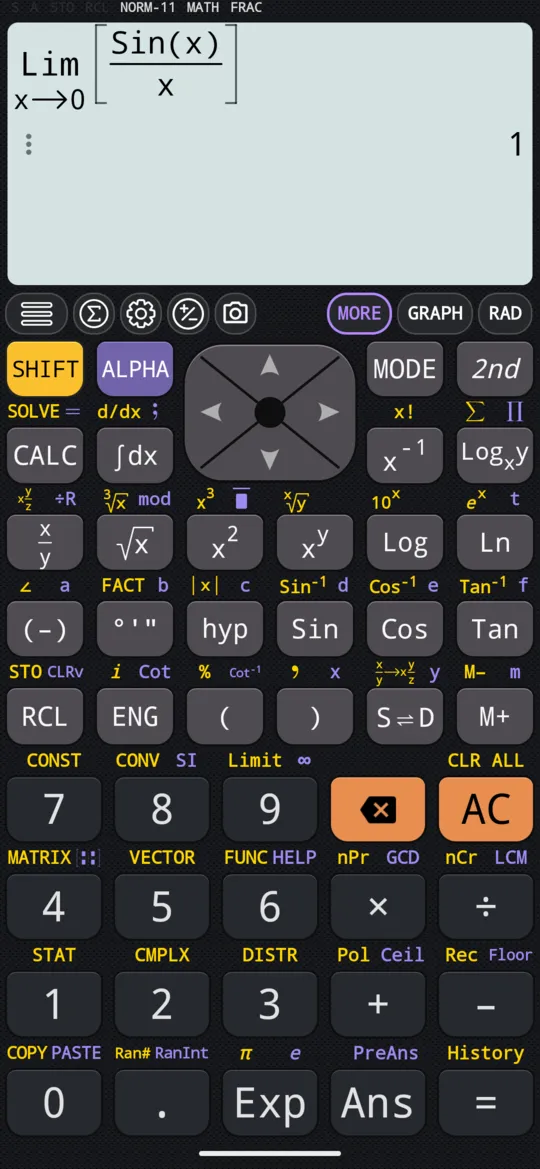
Fill in the point, then press =.
in Lim x→0 [Sin(x)/x]
out 1
At x = 0 the expression is 0/0 and has no value at all, yet it heads for 1.
in Lim x→1 [(x² - 1)/(x - 1)]
out 2
(x²−1)/(x−1) is undefined at x = 1 but equals x + 1 everywhere else, so it heads for 2.
Limits at infinity
To ask what happens as x grows without bound, put ∞ in the point slot. It is the last entry in the limit menu, and ALPHA 9 ∞ types it directly without opening the menu at all.
in Lim x→∞ [7 + Sin(x)/x]
out 7
sin(x)/x shrinks towards 0 as x grows, so only the 7 is left.
in Lim x→∞ [(1 + 1/x)ˣ]
out e
The definition of e: this is where the constant comes from.
One-sided limits
Some expressions head somewhere different depending on the side you approach from. For those the two-sided limit has no answer, and the menu's other two entries ask one side at a time: Lim(expr, x→a⁺) from the right, through values larger than the point, and Lim(expr, x→a⁻) from the left, through values smaller than it.
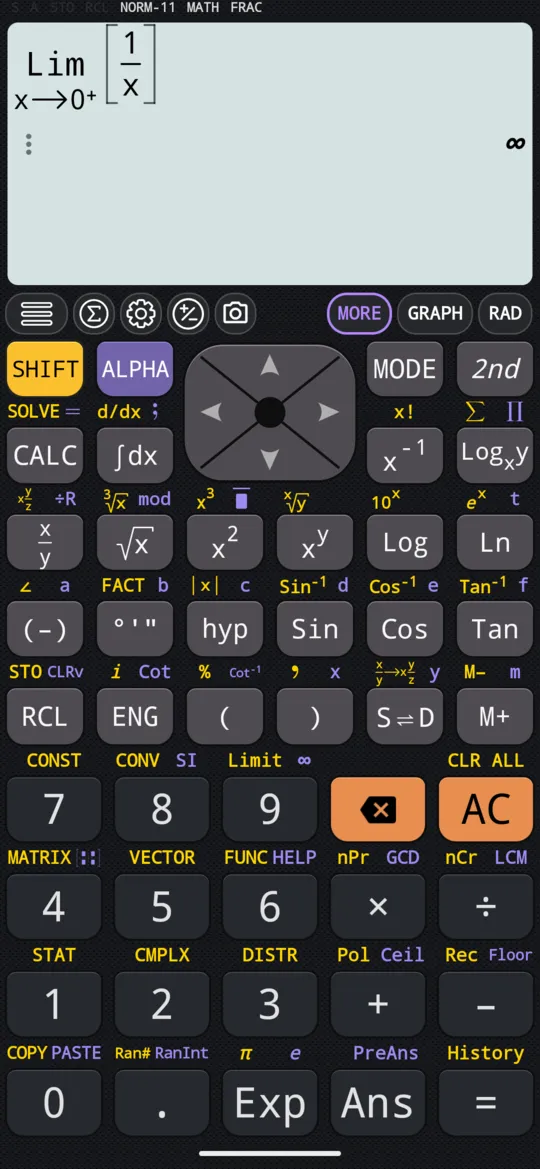
Take 1/x at x = 0. From the right, through 0.1, 0.01 and 0.001, the value climbs without bound; from the left, through −0.1, −0.01 and −0.001, it falls without bound. The two sides disagree, so the two-sided limit does not exist, and asking for it says so.
in Lim x→0⁺ [1/x]
out ∞
in Lim x→0⁻ [1/x]
out -∞
in Lim x→0 [1/x]
out Indeterminate
The same thing happens either side of any vertical asymptote: for 1/(x−1) at x = 1, the limit from the right is ∞ and the limit from the left is −∞.
Reading the answer
- A number, or a constant such as e. The limit exists, and that is its value.
- ∞ or −∞. The expression grows or falls without bound. Strictly the limit does not exist; the answer tells you which way it goes.
- Indeterminate. The calculator could not settle on a value: either the two sides disagree, as 1/x does at 0, or the expression keeps oscillating instead of settling.
Radians, always
Limits always work in radian, whatever the angle unit is set to. That is why sin(x)/x tends to 1 in Degree mode as much as in Radian. When the calculator is not in Radian it says so under the answer, with the note All operands in limit were computed in radian angle unit: it is telling you the setting was ignored, not that anything went wrong.
See the limit on a graph
A limit can be drawn instead of evaluated. Type it on the calculation screen exactly as you would to evaluate it, then press GRAPH: the curve is plotted, with a dashed vertical line at the point x is heading for. Follow the curve to the line from each side and read off the height it aims for. The graph screen itself has a page of its own.
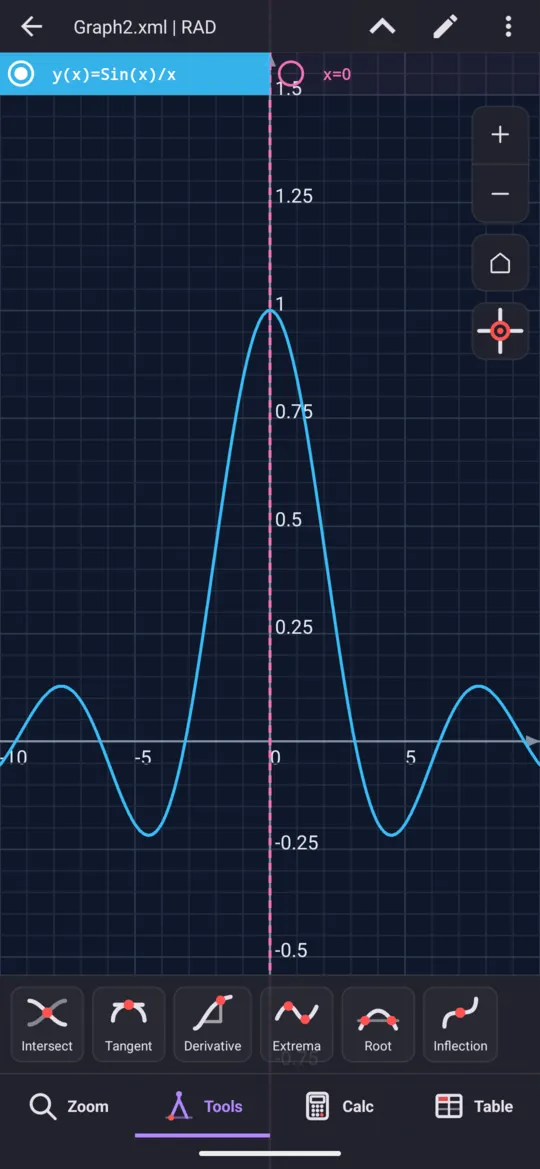
A limit that does not exist is just as plain to see. At x = 1 the two sides of 1/(x−1) run off in opposite directions, which is why the two-sided answer is Indeterminate.
At a glance
| Key or entry | What it does |
|---|---|
| SHIFT 9 Limit | Opens the limit menu |
| ALPHA 9 ∞ | Types ∞ without opening the menu |
| Lim(expr, x→a) | The limit from both sides: expression, variable, point |
| Lim(expr, x→a⁺) | The limit from the right |
| Lim(expr, x→a⁻) | The limit from the left |
| left right | Move between the slots of the template |
| = | Evaluates |
| GRAPH | Draws the curve, with a dashed line at the point |
Questions
How do I find a limit as x approaches infinity?
Put ∞ in the point slot of the limit template. ALPHA then 9 types it without opening the menu. 7 + sin(x)/x heads for 7 as x grows, because sin(x)/x dies away, and (1 + 1/x)^x heads for e.
What does Indeterminate mean when I take a limit?
That there is no single two-sided value: either the two sides head for different places, as 1/x does at 0, or the expression keeps oscillating instead of settling. It does not mean the limit is impossible. Ask for each side on its own before concluding anything.
Can it take a one-sided limit?
Yes. The limit menu has Lim(expr, x→a⁺), from the right through values larger than a, and Lim(expr, x→a⁻), from the left through values smaller than a. For 1/x at 0 they give ∞ and −∞.
Why does the answer say it was computed in radian?
Limits always work in radian, whatever the angle unit is set to, so sin(x)/x tends to 1 in Degree mode as well. When the calculator is not in Radian it prints a note under the answer to say the setting was ignored; nothing went wrong.
Related pages
- Graphing and tables curves, shaded areas, tables of values
Written from the calculator's own manual and from the app itself, version 7.6.0; every figure is one the manual shows or a capture of the app proves. Last revised on 25 September 2026.
Bug reports and feature requests go to kimcuc@samatica.com — a person reads it.